


Modern life makes it easy to end the day exhausted but mentally overstimulated.
You fall into bed tired, yet your brain keeps spinning with thoughts, to-dos, and leftover stress. This “tired but wired” pattern is one reason many people struggle to fall asleep smoothly.
A simple way to change this is by practicing ritual sleep — a purposeful wind-down process that prepares both your mind and body for rest.
A routine is something you do automatically.
A sleep ritual is something you do with intention.
Routines are chores; rituals are signals. When the same relaxing actions happen every night, your brain begins to associate them with sleep. Over time, even the first step of your ritual becomes a cue that rest is coming. That consistency is what makes ritual sleep so powerful.
Below, you’ll learn how sleep rituals interact with your body clock, how to set up a supportive environment, and seven calming rituals you can try tonight.
How Sleep Rituals Support Your Body’s Natural Rhythm
Your Internal Clock and Its Signals

Your body follows a 24-hour rhythm called the circadian cycle. This cycle regulates energy, mood, body temperature, and the natural rise and fall of sleepiness. Two main factors influence this rhythm:
- Light exposure
- Consistent habits
In the morning, light naturally tells your brain to wake up. In the evening, familiar calming actions — such as reading or dimming lights — help your brain recognize that the day is ending. Sleep rituals strengthen those cues by creating predictable evening patterns.
The Wind-Down Window
Instead of going from active to asleep instantly, your nervous system needs a transition period. A 30–60 minute wind-down window allows your heart rate, body temperature, and mental activity to gradually shift into a restful state.
Skipping this transition often leads to:
- Racing thoughts
- Feeling restless
- Difficulty “switching off”
- Frustration in bed
A sleep ritual fills this window with simple, calming steps that guide your mind and body toward rest.
The Psychological Benefit of Ritual
Rituals create a sense of predictability. When your brain knows what’s coming next, it feels safe enough to relax. Engaging in the same steps — in the same order — builds a gentle rhythm that quiets mental noise.
This predictable pattern becomes especially valuable if your mind tends to stay busy at night.
The Core Pillars of Effective Sleep Rituals
Before choosing specific rituals, create a sleep-friendly environment. These four pillars form the foundation of your nightly wind-down.
1. Temperature
Most people sleep best in a cool room — around 65–68°F (18–20°C). A cooler environment supports your body’s natural drop in temperature before sleep.
Simple ways to optimize temperature:
- Use breathable bedding
- Turn on a fan
- Lower the thermostat slightly
- Dim lights to reduce heat in the room
2. Lighting
Light is one of the strongest signals to the brain.
Blue light — found in daylight and screens — keeps you alert. In the evening, shift toward warm, soft light.
Try:
- Warm-toned bulbs
- Dim lamps instead of overhead lighting
- Reducing screen exposure
- Using warm filters if needed
3. Sound
Your sound environment can make or break your ability to unwind.
Options include:
- White noise
- Pink noise
- Soft nature sounds
- A quiet environment
Choose whatever soundscape feels calming and consistent.
4. Digital Detox
Screens stimulate your mind and delay natural sleepiness. Turning off devices 1–2 hours before bed supports smoother transitions into rest.
Good alternatives include reading, journaling, stretching, or listening to calming audio.
7 Powerful Sleep Rituals to Try Tonight
These seven rituals are simple, practical, and easy to begin. Start with one or two and build from there.
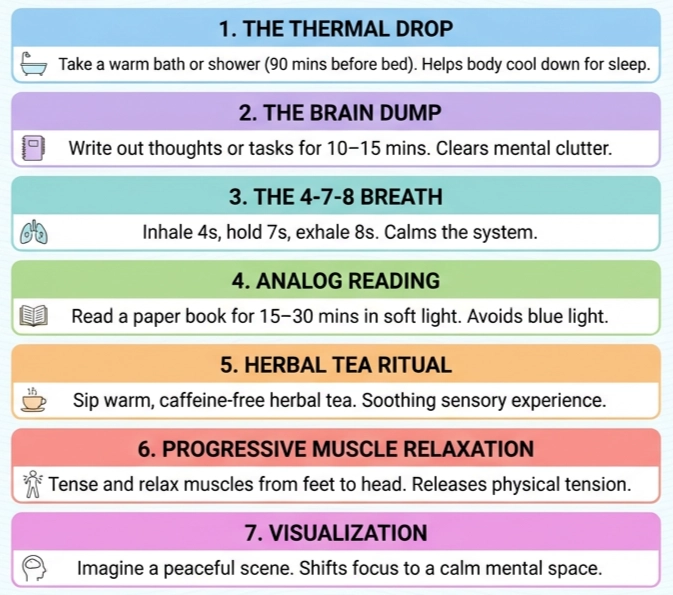
1. The Thermal Drop (Warm Bath or Shower)
The Ritual:
Take a warm bath or shower about 90 minutes before bed.
Why It Works:
Warm water causes your body to release heat afterward, helping your temperature drop — a natural cue for sleep.
How to Do It:
- Keep water comfortably warm
- Stay in for 10–15 minutes
- Follow with a quiet cool-down activity
This creates a strong physical shift that supports a smoother transition to bed.
2. The Brain Dump (Evening Journaling)
The Ritual:
Spend 10–15 minutes writing out your thoughts, worries, or tomorrow’s tasks.
Why It Works:
Putting thoughts on paper reduces mental clutter and helps quiet an overactive mind.
How to Do It:
- Keep a dedicated journal
- Write freely without editing
- List 2–3 things you appreciated today
- Close the journal when finished
This ritual is especially helpful if thinking keeps you awake.
3. The 4-7-8 Breath (Simple Relaxation Technique)
The Ritual:
Use the 4-7-8 breathing pattern to calm your system.
Why It Works:
Slow, intentional breathing encourages relaxation.
How to Do It:
- Inhale for 4 seconds
- Hold for 7 seconds
- Exhale for 8 seconds
- Repeat 4 cycles
A minute of this can create noticeable ease.
4. Analog Reading (Paper Books Only)
The Ritual:
Read a paper book for 15–30 minutes in soft lighting.
Why It Works:
Reading gently engages the mind without overstimulation and avoids blue light.
How to Do It:
- Choose light, enjoyable genres
- Read in dim, warm lighting
- Keep electronics in another room
This is one of the simplest and most effective nighttime rituals.
5. Herbal Tea Ritual (Warm, Caffeine-Free Drinks)
The Ritual:
Sip a warm herbal tea like chamomile or magnesium blends.
Why It Works:
The warmth, aroma, and slow sipping create a soothing sensory experience.
How to Do It:
- Use caffeine-free blends
- Drink slowly
- Enjoy during your wind-down window
6. Progressive Muscle Relaxation (PMR)
The Ritual:
Tense and relax major muscle groups from feet to head.
Why It Works:
PMR helps release tension and promotes physical ease.
How to Do It:
- Lie comfortably
- Tense each muscle group for 5 seconds
- Release and move upward
- Finish with a minute of stillness
7. Visualization (The Imaginary Walk)
The Ritual:
Imagine a peaceful scene and mentally “walk” through it.
Why It Works:
Visualization shifts your focus away from stress and into a calm mental space.
How to Do It:
- Close your eyes
- Picture a beach, forest, or meadow
- Engage all senses
- Return to the imagery when your mind drifts
Customizing Your Ritual Sleep Practice
Not everyone winds down the same way. Here are tailored suggestions for different lifestyles.
For Overworked Parents
Use a quick 15-minute sequence:
- 5 minutes of digital detox
- 7 minutes of breathing or journaling
- 3 minutes of visualization in bed
Consistency matters more than duration.
For Busy Thinkers
Focus on mental offloading:
- 20 minutes journaling
- 10 minutes PMR or breathing
- 10 minutes visualization
For Night Shift Workers
Support daytime sleep with:
- Blackout curtains
- White noise
- A cool room
- A short wind-down ritual before daytime sleep
How to Make Sleep Rituals Last
Consistency is more important than intensity.
Start with one ritual and practice it for 2–3 weeks. After it becomes familiar, add a second ritual to strengthen your evening routine.
Track small improvements:
- Falling asleep faster
- Fewer nighttime awakenings
- Feeling more refreshed
- A quieter mind at night
These subtle shifts show your ritual is working.
Your 5-Step Ritual Sleep Action Plan
- Choose your first ritual
- Commit to it for 21 days
- Track your sleep patterns
- Add a second ritual
- Share your progress with someone for accountability
A calm night begins with one small, intentional step.
Conclusion
Ritual sleep transforms your evenings by giving your mind and body a predictable, soothing pathway into rest. You don’t need an elaborate system — just a few intentional steps repeated consistently. Start tonight with one ritual, give it time, notice how your nights begin to change.
A peaceful night begins with a simple ritual.
Frequently Asked Questions About Ritual Sleep
How long should my sleep ritual be?
Most people benefit from 30–60 minutes. A short 15-minute ritual still helps if you’re consistent. The key is repetition, not duration.
Does reading on a phone count as a sleep ritual?
No. Phones and tablets emit stimulating light and keep your brain active. Choose paper books instead.
When should I start my sleep ritual?
Begin 30–90 minutes before your intended sleep time. If your day was stressful, give yourself extra transition time.
Can I combine multiple rituals?
Absolutely. Many people build powerful sequences like: warm bath → journaling → breathing → reading → bed.
What if my ritual doesn’t work immediately?
Practice for at least 2–3 weeks. If you don’t notice any improvement, adjust one element rather than starting over completely.
Can sleep rituals help if I eat late at night?
Late-night eating can make rest harder. If this is an issue for you, consider lighter foods and allow some digestion time before bed.